
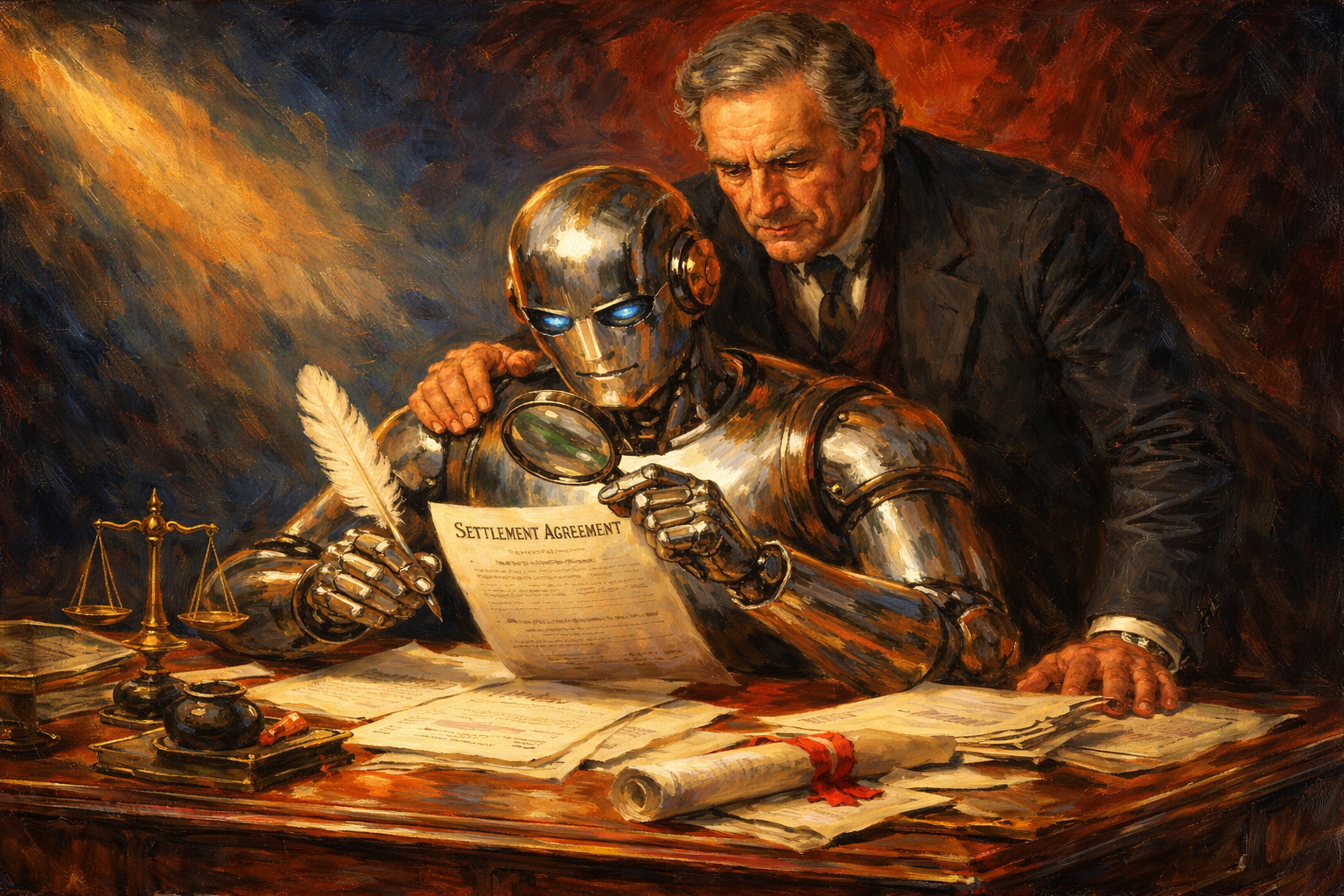
There is a version of AI-assisted legal work that should concern every employer. It involves typing a request into a general-purpose AI tool, receiving something that looks authoritative, reads fluently, and contains a flaw that won’t become apparent until it causes a problem. The document passes the eye test. It doesn’t pass the legal one.
This isn’t a hypothetical. It’s already happening. And the employers most at risk aren’t the ones ignoring technology — they’re the ones embracing it without understanding where it falls short.
The Confidence Problem
General AI tools are extraordinarily good at producing text that sounds correct. In employment law, that’s a particular hazard. Like the settlement agreement I saw that omitted wording to satisfy the statutory requirements, rendering it defective, or an employment contract with a post-termination restriction drafted in terms that make it patently unenforceable, won’t announce its own defects. It will look like every other document of its kind. The problem surfaces later — at tribunal, in a dispute, or an ex-employee that walks away with your customers, when the clause you were relying on turns out to be worthless.
The issue isn’t that AI produces bad drafts. Often the drafts are impressive. The issue is that AI cannot exercise legal judgment. It cannot weigh the specific facts of your situation, apply current case law, identify where the standard template doesn’t serve your interests, or tell you when what you’ve asked for isn’t actually what you need. Those are things a qualified, experienced employment solicitor does. They are not things that can be automated away.
The False Economy of Going Direct to AI
For employers who’ve been paying high hourly rates for employment legal work, the temptation to simply cut out the lawyer and use AI directly is understandable. The logic runs: the lawyers are probably using AI anyway, so why pay for the intermediary?
The answer is that what you’re paying for isn’t the drafting. It’s the checking and judgment applied to the draft. It’s the solicitor who reads your settlement agreement and spots that the tax indemnity clause doesn’t reflect the actual payment structure. Or who notices that your disciplinary procedure conflicts with your contract terms in a way that could undermine a future dismissal. Or who knows — from years of tribunal work — exactly how an employment judge will read the clause you’ve just included.
That expertise cannot be replicated by prompting an AI more carefully. It comes from experience, specialism, and professional accountability. A solicitor who signs off on a document is responsible for it in a way that no AI tool ever will be.
Where AI Genuinely Helps — and Where It Doesn’t
Used properly, AI is a significant advance for legal services delivery. For routine employment documents — standard settlement agreements, employment contracts, HR policies — AI can produce a high-quality first draft quickly and consistently. It removes the slow, mechanical part of the process. It reduces the cost of getting to a solid starting point.
What it cannot do is finish the job. The first draft still needs a qualified eye. Specific instructions need to be incorporated correctly. Edge cases need to be spotted. The document needs to be considered in the context of your business, your sector, and the specific situation it’s designed to address.
This is why the model that actually works is AI plus solicitor — not AI instead of solicitor. The technology handles the volume and speed. The solicitor handles the judgment and accountability. Neither works as well without the other.
What to Look For When Instructing Anyone
If you’re using a legal services provider that incorporates AI, ask a direct question: who is the qualified solicitor responsible for this document, and what specifically do they review? If the answer is vague, or if the proposition seems to be that AI alone produces the output, treat that as a warning sign.
At EmploymentSolicitor.com, every document is reviewed and finalised by a named, senior employment solicitor — a specialist, not a generalist. The AI accelerates the process. The solicitor is responsible for what leaves the door. That distinction matters, practically and legally.
The Right Balance Exists
Employers don’t have to choose between expensive traditional law firms and the risk of unreviewed AI output. A third option has emerged: AI-augmented legal services where qualified solicitor oversight is built into the process from the start, not bolted on as an afterthought, and where the fee reflects the genuine efficiency of the model.
That’s the standard worth holding your legal services providers to. Not whether they use AI — most now do, or will shortly. But whether a qualified solicitor is genuinely, meaningfully in the loop. Because in employment law, that’s still the thing that matters most.